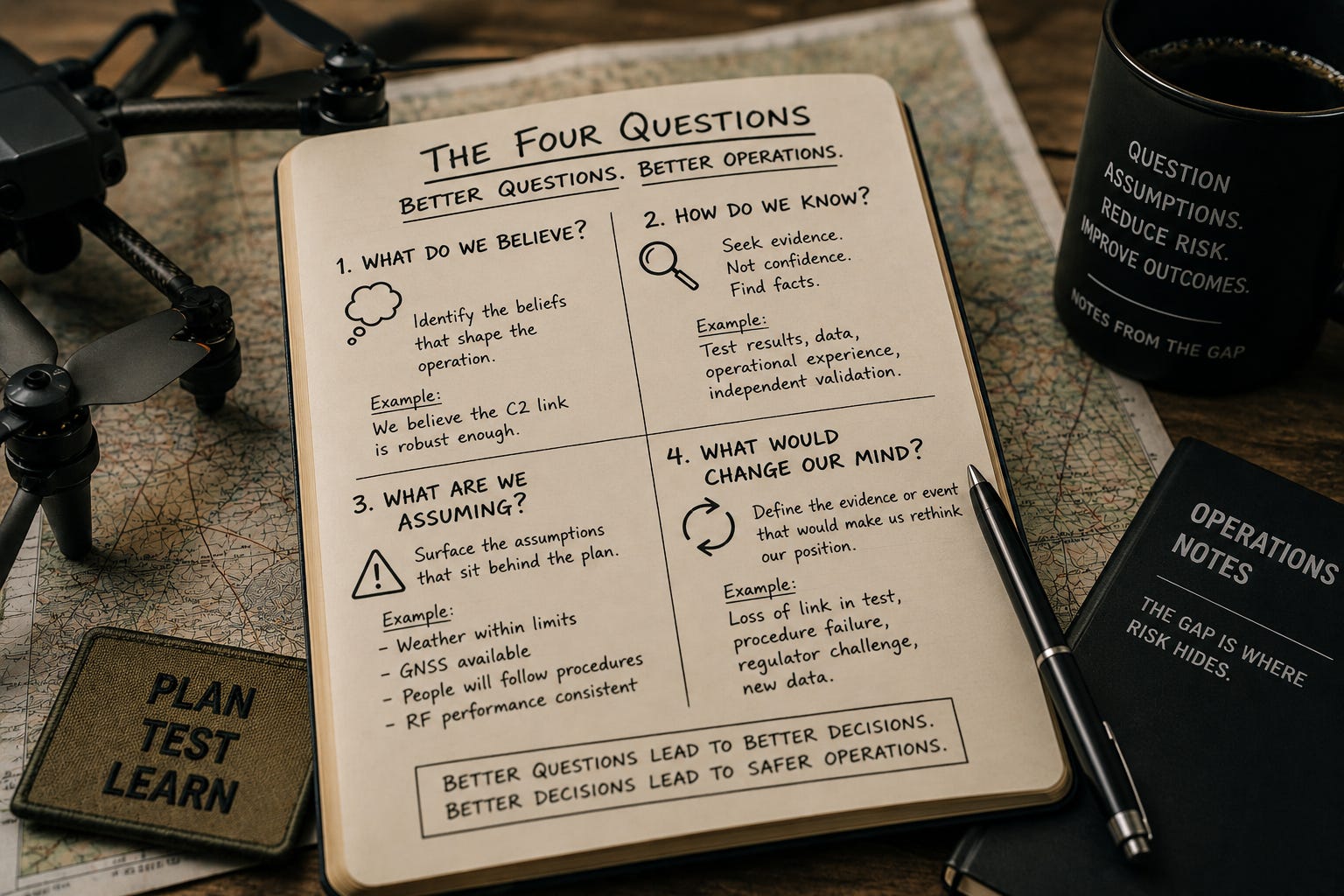
The four questions every operator should ask

Over the years, I’ve had the privilege of working with some exceptional operators, engineers, regulators and test teams. They all came from different organisations, had different experiences, and often approached problems in completely different ways. Yet, looking back, I’ve realised they all seemed to share one habit.
They asked better questions.
Not more questions. Better ones.
It wasn’t always obvious at the time, and I doubt many of them consciously followed the same process, but the pattern has become increasingly clear to me. The strongest operational decisions I’ve witnessed have almost always been preceded by four simple questions.
They’re not unique to aviation and they’re certainly not unique to UAS. In fact, I’d argue they apply to almost any complex activity where people, technology and uncertainty come together.
They’re also deceptively simple.
What do we believe?
How do we know?
What are we assuming?
What would change our mind?
On the surface, they sound almost too straightforward to be useful. In reality, I’ve found they expose weaknesses in an operation remarkably quickly.
The first question is usually the easiest.
What do we believe?
Every operation begins with beliefs. We believe the aircraft can achieve a particular endurance. We believe the command and control link is sufficiently robust. We believe the weather forecast is accurate enough to support the mission. We believe our procedures are appropriate, and we believe the people carrying them out understand them.
There’s nothing wrong with belief. In fact, planning would be impossible without it. The problem is that beliefs have a habit of becoming facts in our own minds long before they’ve earned that status.
That’s why the second question matters so much.
How do we know?
It’s surprising how often this question changes the conversation.
I’ve sat in meetings where everyone around the table was convinced a particular capability existed, only for somebody to ask how we actually knew. Suddenly the discussion changed from certainty to evidence. Instead of repeating assumptions, people began searching for demonstrations, test results, operational experience and observations that genuinely supported the claim.
Sometimes the evidence was there.
Sometimes it wasn’t.
And occasionally everyone realised they had simply inherited somebody else’s confidence.
That’s an uncomfortable moment, but it’s also an incredibly valuable one.
The third question is where things become even more interesting.
What are we assuming?
Every operation contains assumptions. They aren’t signs of poor planning; they’re an unavoidable consequence of working in uncertain environments. We assume radio performance will remain consistent. We assume GNSS coverage will be available. We assume operators will behave in predictable ways under pressure. We assume the environment won’t introduce something we’ve never encountered before.
The danger isn’t that assumptions exist.
The danger is that they slowly disappear into the background until nobody remembers they’re assumptions at all.
After enough successful flights, an assumption can quietly transform into “something we know”.
Except we don’t.
We simply haven’t challenged it recently.
I’ve come to think of assumptions as operational debt. Much like technical debt in engineering, they accumulate quietly while everything is working well. Most of the time they remain invisible, right up until the operation becomes more ambitious, more complex or moves into a new environment. Then suddenly that debt has to be repaid, often at exactly the moment you’d rather it didn’t.
The final question is probably my favourite because it says more about an organisation than almost anything else.
What would change our mind?
When I ask this during reviews or planning sessions, there’s often a pause.
Not because people don’t understand the question, but because they’ve never really considered it.
If our aircraft loses the command link under conditions we believed were well within its limits, would that change our understanding?
If a procedure that worked perfectly during rehearsals falls apart under operational pressure, would we rethink it?
If a regulator challenges an argument we’ve been confident about for months, are we prepared to revisit our thinking?
Or have we already decided we’re right?
To me, this is the point where testing and proving part company.
Testing accepts the possibility that our understanding is incomplete.
Proving begins with the assumption that we’ve already reached the answer.
One is driven by curiosity.
The other by confirmation.
The best operators I’ve worked alongside have always been willing to change their minds when the evidence demanded it. Not because they lacked confidence, but because they understood that confidence should follow evidence, not replace it.
Looking back over the articles I’ve written so far, I realise these four questions have been there all along.
The gap exists because belief and reality rarely align perfectly.
Evidence helps us understand what we actually know.
Assumptions explain why operations drift away from the plan.
Testing provides opportunities to change our minds before the real world does it for us.
Perhaps that’s why these four questions have become increasingly important to me. They aren’t really questions about aircraft or regulations.
They’re questions about thinking.
And if there’s one lesson the industry has taught me over the years, it’s that better operations rarely start with better answers.
They start with better questions.
—
The Four Questions
Before your next operation, test, design review or SORA, ask yourself:
What do we believe?
How do we know?
What are we assuming?
What would change our mind?
You might be surprised by the conversation that follows.
— Notes from the Gap